Ordered by the number of ascents recorded.
| Climb Name | Type | Grade | # Ascents Recorded | Notes | Exclude Reason |
|---|---|---|---|---|---|
| Gaia | Trad climb | E8 | 32 |
A classic Johnny Dawes test piece. A hard move gains entry to the groove where easier climbing awaits before a terrifying finale. |
|
| End of the Affair | Trad climb | E8 | 30 | ||
| The Master's Edge | Trad climb | E7 | 27 |
A Peak District test piece, the soaring arête was so named because, while working the line, Jerry Moffatt proclaimed:
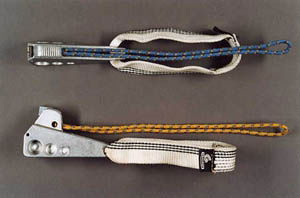
Jerry was preparing for a solo ascent. Meanwhile, Ron Fawcett found that a new and obscure sliding nut, the Edelrid Amigo [2,3], fitted the quarrymen’s shotholes, which lie just over halfway between the ground and the crux. Keen not to be outdone by the up-and-coming Moffatt, Ron promptly led the route after minimal inspection. The gear went untested and the Master showed he still had the edge… In the 2010s a marginal slider placement was discovered in the first part of the route, taking some of the sting out of the solo to the shotholes. Around 2024–2025 someone took a fall onto the slider and blew the placement out in the process. References[1] On The Edge Issue 107, page 48 [2] https://www.ukhillwalking.com/photos/dbpage.php?id=416863 |
|
| Cobra Crack | Trad climb | E9 | 25 |
References[1] https://open.spotify.com/episode/2Ydq78HiAujHdEy0t4hp1R? |
|
| Greenspit | Trad climb | E9 | 25 | ||
| Freerider | Trad climb | E7 | 22 |
Originally climbed as an easier variation of Salathé Wall, avoiding the hard crack pitches on the headwall, Freerider is now one of the most popular free routes on the main face of El Capitan. In 2017, Alex Honnold made history with an audacious free solo of the route after extensive preperation. His solo was filmed for the 2018 feature film Free Solo. In November 2024 Barbara Zangerl flashed the route, making her the first person to flash a free route on El Capitan. Cédric Lachat and Pete Whittaker both made ascents which could be considered flashes by some definitions but both ascents came with caveats. The route's origins stem from Todd Skinner and Paul Piana's ascent of the Salathé, where they considered bypassing some of the hardest climbing via parts of what was to become Freerider, but opted to follow the original aid line as closely as they were able to. The full line was conceived by Alex Huber whilst working on his free ascent of the Salathé Wall in 1995. He rope-soloed the four-pitch variation to the headwall that year but waited three years before climbing the whole route with his brother Thomas in 1998. There are two common variations that make up the crux of the route, The Boulder Problem at around 7c+ sport or 7B/+ boulder or The Teflon Corner at around 7c sport. The boulder problem is short and dynamic, while the teflon corner features extremely technical and insecure smearing. While the rest of the route is seldom easy, the other notable hard pitches are The Monster Offwidth and The Enduro Corner. Dan McManus on The Monster Offwidth:
References[1] https://danmcmanus.blogspot.com/2016/03/a-guide-to-freerider.html [2] https://publications.americanalpineclub.org/articles/12199901800 |
|
| Meshuga | Trad climb | E9 | 21 |
The prow at Black Rocks is one of the most impressive and uncompromising features on gritstone and for decades was regarded as a Last Great Problem. Attention in the late ‘80s and early ‘90s focused on the prow’s left arête, with climbing said to be around 8b. Whilst top-roping Seb Grieve on the line, Quentin Fisher suggested trying to link to a line of better holds on the right arête. With a bit of beta refinement from Dave Jones, the line of Meshuga was unlocked and Seb made his ascent in 1997. It was perhaps the boldest route on gritstone at the time, comprising unpredictable 7c climbing, a long way above a terrible landing. The name comes from the Yiddish word for Insane. [1] Despite its boldness, it has become one of the most repeated E9s. The left arête remains unclimbed.
References[1] ‘Peak Rock’, Vertebrate Publishing, 2013. [2] https://www.geocities.ws/readza1/climbing/gritlist/grit_e9.html |
|
| Strawberries | Trad climb | E7 | 21 |
A defining route of the Ron Fawcett era, and one of the most prized onsights in the UK. The route tackles a tasty crackline, followed by a fruity runout up the Vector headwall. Fawcett initially tried the route in 1978; despite remaining unclimbed, Chris Griffiths' photo of the route was the cream of the crop, earning the cover of the 1978 Tremadog and the Moelwyns Climbers Club guidebook. [2][3] The project lay unchallenged for 18 months until John Redhead was spotted making attempts. Fawcett got wind of this and returned, finding the route to be just as hard-going as before. On day one, he climbed ground-up, but ran out of juice. On day two, feeling the pressure to get the project done, he abseiled down to pre-place and pre-clip the gear he'd established the day before. Seeing red, a desperate fight ensued:
Fawcett graded the route E5 7a. Today the route is graded E7, with climbing around the 7b+/7c mark. He named it Strawberries, as an accompaniment to the neighbouring route on the headwall, Cream (E4). As a project, it had been known as Peaches. Other fruity dessert-themed names proved irresistible (Dream Topping (E7), Bananas (E5)). Stefan Glowacz made the historic first onsight of the route in 1987, running it out with no gear above the crack. Glowacz' extraordinary onsight effort would not be matched until Jorg Verhoeven succeeded in 2011. Steve McClure was the first British climber to onsight the route in 2014. Nearly five decades on, Strawberries remains as fresh as ever. References[1] Jack Geldard on the history of the route https://www.ukclimbing.com/articles/features/strawberries_-_a_british_on_sight-1117 [2] https://www.ukclimbing.com/photos/dbpage.php?id=411731 [3] https://www.ukclimbing.com/photos/dbpage.php?id=411732 [4]Ed Douglas, Ron Fawcett: Rock Athlete, Vertebrate Publishing, 2010 |
|
| Le Voyage | Trad climb | E10 | 20 |
References |
|
| Mission Impossible | Trad climb | E9 | 18 |
Around 8a+ to 8b difficulty wise, protected by pegs and small wires. The in-situ gear has changed since the first ascent:
James Taylor re-equipped the route in 2021:
References[1] https://www.ukclimbing.com/news/2026/07/mission_impossible_the_most_possible_e9_in_the_uk-74180 |
|
| Right Wall | Trad climb | E5 | 18 |
A psychological breakthrough hailed at the time as one of the most difficult routes in the UK. Whilst clearly a step-up from the Brown-Whillans era, with the benefit of hindsight, there were already a number of harder routes by the time of its first ascent. Nonetheless it possessed a considerable cachet until attaining trade-route status by the mid-1980s. |
|
| The Nose | Trad climb | E9 | 18 |
The Nose is one of the most monumental and iconic rock climbs in the world, taking the most prominent line up the middle of El Capitan. Prior to its free ascent, it had a long and storied history as an aid route, still the most popular way up El Cap today. The free ascent was an obvious longstanding challenge, with sections were freed by many different people, not always formally recorded, before Lynn Hill's completely free ascent in 1991. Much of the route is climbed by pitches from fairly moderate up to 5.12d. However, the burly Great Roof (5.13c/8a+) and notoriously technical Changing Corners (5.14a/8b+) pitches, both high on the route, have stopped even some of the best climbers. The Stoveleg Cracks were first freed by Jim Bridwell in June 1967 after attempts in 1965 partnering Frank Sacherer, who originally conceived they might be climbable without aid. In 1975 John Bachar, Dale Bard and Ron Kauk had climbed ~85% free, all but 120m, at ~5.11+. In Spring 1980 Ray Jardine spent 4 months working the route, fixing ropes, managing to climb as far as the Great Roof free, but only after chipping four holds on the Jardine Traverse to avoid the King Swing pendulum. So far (as of 2025), all subsequent free ascents have taken this traverse. In Fall 1990, Brooke Sandahl and Scott Franklin climbed all but four pitches free, the remaining aided sections were the Great Roof, the pitch above Camp 5, Changing Corners, and the final Harding bolt ladder. Working top-down, Sandahl freed the Harding bolt ladder in 1991 (5.12c/7b+) and, with Dave Schultz, freed the pitch above Camp 5 in 1992 (5.12d/7c). They prepared the route for a free ascent, including bolting a variation just to the left of the aid line on the Changing Corners pitch, but were unable to climb this. Lynn Hill partnered by Simon Nadin, first free climbed the Great Roof on a ground-up attempt in 1993, but they were unable to completely free the Changing Corners by either the original line or the Sandahl/Schultz variation. All but ten feet of the route had now been free-climbed. Hill and Sandahl joined forces later in the summer of 1993 and began working the Changing Corners pitch top-down, Sandahl focusing on his left-hand variation, Hill on the original aid line. Hill was able to climb all the moves on the latter, with two falls. In September 1993, Hill made a completely free ascent of the route from the ground, leading all the hard pitches. She returned the following year to climb the whole route in a day – an astounding achievement. Notable repeats include Keita Kurakami's rope solo, Sébastien Berthe's ground-up, and Connor Herson's rapid ascent in just nine and a half hours. References[1] https://alpinist.com/features/birds-eye-view/ [2] http://www.edhartouni.net/nose-in-a-day.html [3] https://www.rayjardine.com/Papers/Magazine-Articles/index.php?StoryPage=7 [4] https://www.rayjardine.com/Avocations/Rock-Climbing/index.php [5] https://climbingzine.com/brooke-sandahl-beginnings-freeing-nose/ [6] https://publications.americanalpineclub.org/articles/12199404100/El-Capitans-Nose-Climbed-Free |
|
| Divided Years | Trad climb | E9 | 17 |
One of the most compelling single pitch lines out there, Divided Years tackles a 55m prow at Buzzard's Roost in the Mournes. It was the first route to be given E10 in the world in 1994, and was said to feature 8c climbing. It now rates E9, with climbing around 8a+. James McHaffie and Ryan Pasquill made ground-up ascents with minimal beta and prep in 2015. Robbie Phillips made a well-prepared flash of the route in 2026. Jack Geldard, UKC:
|
|
| Knockin' on Heaven's Door | Trad climb | E8 | 17 |
One of the eight ‘last great problem’ projects listed in the Derwent Grit guide. [1] Jerry Moffatt did all the moves, Johnny Dawes top roped it in a oner, Ron Fawcett was hovering, but it was Andy Pollitt who tied into the sharp end, jumped through the crux and wobbled through to the top – narrowly avoiding a disastrous fall when he slipped on the final sloping ledges.
The grade of a given ascent depends on the particular gear placements used. The first ascent and early repeats used a peg in a slot high on the left. Later repeats used a cam in a good slot at half height, though this requires a traverse to access. Some people have combined the cam and the pegs, some people have used neither! References[1] The others were Dharma, Gaia, End of the Affair, Kaluza Klein, Soul Doubt, The Screaming Dream and The Groove. [2] https://www.ukclimbing.com/news/2010/10/ryan_pasquill_flashes_knockin_on_heavens_door-58563 |
|
| Belly Full of Bad Berries | Trad climb | E8 | 15 | ||
| Electric Avenue | Trad climb | E8 | 15 | ||
| Golden Gate | Trad climb | E8 | 15 |
Golden Gate climbs the first 21 pitches of Salathe/Freerider then ~9 new pitches links it into the last 7 pitches of El Corazon. |
|
| Muy Caliente! | Trad climb | E9 | 15 | ||
| Rare Lichen | Trad climb | E9 | 15 | ||
| Salathé Wall | Trad climb | E8 | 15 |
5.13c/8b, and likely E9, if the headwall is climbed in a single pitch. References[1] https://www.climbing.com/culture/climbing-style-el-capitan/ [2] Details of the incremental freeing of the route https://web.archive.org/web/20170213064201/[http://www.stanford.edu/~clint/yos/longhf.htm#salathe](http://www.stanford.edu/~clint/yos/longhf.htm#salathe) |