Climbing History
A selected history of climbing and mountaineering through the climbers, climbs and media.
4710 Climbers
8364 Climbs
22388 Ascents
Featured
Alain Ghersen
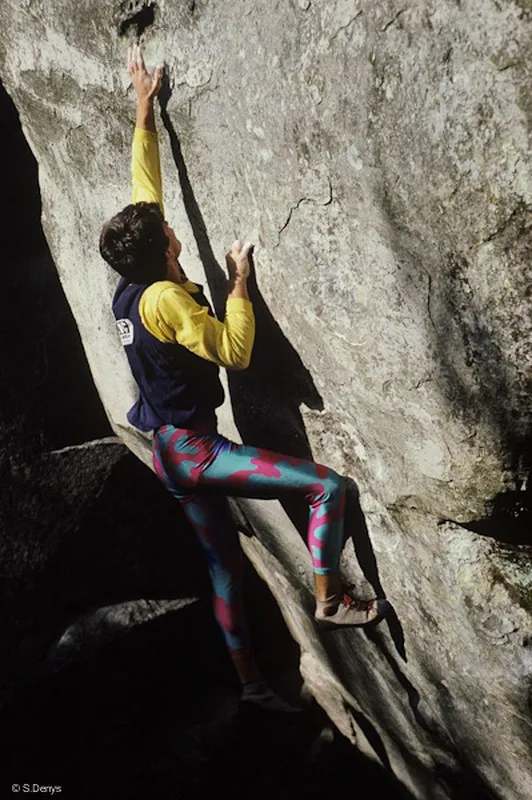
Prolific Bleausard boulderer and alpinist, breaking new ground in both disciplines.
In bouldering he established the first 7C+ in the forest with Le Surplomb de la Mée (Pre-Break) in 1983, and had a claim to the first 8A+ with L'Aplat Du Gain (now 8A) in 1988. In 1987, he succeeded in climbing all problems in Fontainebleau graded 7A or above. [2]
However, his alpine achievements are even more astounding:
Another champion of Bleau and beyond in the 1980s: Alain Ghersen. His personal obsession was to statically climb every move that others tackled dynamically. No more dynos — a technique commonly used in Bleau on boulders where bad falls are unlikely. Unlike Jérôme Jean-Charles, Alain Ghersen — now a mountain guide and instructor at ENSA — is a world-class alpinist. His solo ascents in the Mont Blanc massif, especially his link-ups in the late 1980s, left a lasting mark on the history of alpinism.
In an unpublished profile of Pierre Allain ('Pierre Allain, or the Prevalence of Pleasure, April 2015'), Alain Ghersen recounts a baroque link-up from the summer of 1987: a Paris–Bleau–Saussois–Chamonix journey starting from one of the most renowned routes in the forest, Le Carnage at Bas-Cuvier. Alain Ghersen: “In just over 40 hours, I linked together ascents of Carnage (7B) in Bleau, Bidule (8a+) in Saussois, and the full Peuterey Ridge on Mont Blanc — all solo.”
In the summer of 1990, Alain Ghersen once again demonstrated the extraordinary technique and endurance he had developed in Bleau on its most extreme circuits. Solo, without any self-belaying, and in a single continuous push, Ghersen climbed the Directe Américaine on the Drus, the Walker Spur on the Grandes Jorasses, and the full Peuterey Ridge. Three historic, major alpine routes — it’s hard to top that. [1]
References
[1] Modica, Godoffe, 'Fontainebleau: 100 ans d'escalade', p.232, Les Editions Mont Blanc, 2017
[2] OTE Guide, 1997
Prolific Bleausard boulderer and alpinist, breaking new ground in both disciplines.
In bouldering he established the first 7C+ in the forest with Le Surplomb de la Mée (Pre-Break) in 1983, and had a claim to the first 8A+ with L'Aplat Du Gain (now 8A) in 1988. In 1987, he succeeded in climbing all problems in Fontainebleau graded 7A or above. [2]
However, his alpine achievements are even more astounding:
Another champion of Bleau and beyond in the 1980s: Alain Ghersen. His personal obsession was to statically climb every move that others tackled dynamically. No more dynos — a technique commonly used in Bleau on boulders where bad falls are unlikely. Unlike Jérôme Jean-Charles, Alain Ghersen — now a mountain guide and instructor at ENSA — is a world-class alpinist. His solo ascents in the Mont Blanc massif, especially his link-ups in the late 1980s, left a lasting mark on the history of alpinism.
In an unpublished profile of Pierre Allain ('Pierre Allain, or the Prevalence of Pleasure, April 2015'), Alain Ghersen recounts a baroque link-up from the summer of 1987: a Paris–Bleau–Saussois–Chamonix journey starting from one of the most renowned routes in the forest, Le Carnage at Bas-Cuvier. Alain Ghersen: “In just over 40 hours, I linked together ascents of Carnage (7B) in Bleau, Bidule (8a+) in Saussois, and the full Peuterey Ridge on Mont Blanc — all solo.”
In the summer of 1990, Alain Ghersen once again demonstrated the extraordinary technique and endurance he had developed in Bleau on its most extreme circuits. Solo, without any self-belaying, and in a single continuous push, Ghersen climbed the Directe Américaine on the Drus, the Walker Spur on the Grandes Jorasses, and the full Peuterey Ridge. Three historic, major alpine routes — it’s hard to top that. [1]
References
[1] Modica, Godoffe, 'Fontainebleau: 100 ans d'escalade', p.232, Les Editions Mont Blanc, 2017
[2] OTE Guide, 1997
On this day 27th October
- 1958 Todd Skinner was born
- 1987 Kílian Jornet was born
- 1997 Flo Tilley was born
- 2007 Derek Thatcher climbed Angel of Pain 8b+ at Dark Castle
- 2018 Shawn Raboutou made the first ascent of Off the Wagon Low 8C+ in Valle Bavona
- 2023 Anak Verhoeven climbed La Fuerza de la Gravedad E9 at Vadiello
- 2024 Connor Herson made the first ascent of Resurrection Free E8 on The Rostrum
- 2025 Stefano Carnati climbed Deep Fake 8C+ in Brione
Pics + Vids
Featuring 10959 pictures and videos. Try searching for a climber, climb or summit to see pics and videos.
Support

If you've enjoyed using climbing-history.org please consider supporting the project by joining the patreon. Your support helps pay for the hosting required to keep the site running. Everyone who donates gets added to the supporters page.

You may also be interested in the Mountain Heritage Trust, a charity dedicated to preserving the rich history of climbing and mountaineering. Their collection includes many unique and valuable items, from rare guidebooks through to the boots worn by Doug Scott on the 1977 Ogre expedition.
Explore
Fancy a look around? You can browse by climber or by climbs, or you can check out some lists. For example
- All sport ascents of 9b or above
- British women who have climbed 7C or above
- British men who have climbed 8c or above
Podcasts
Featuring 4377 podcasts. Try searching for a climber to see podcasts with them, or check out some of these podcasts:
- Mark Hudon and Jordan Cannon on The Enormocast (2019)
- Rhoslyn Frugtniet on Lattice Training (2021)
- Cameron Hartley on Lattice Training (2024)
- Sam MacIlwaine on Dirtbag State of Mind (2025)
Library
Featuring 16222 items in the library. Try a search to see what you can find, or check out these library items:
- Mountain of Storms (1972) Film
- Alpine Journal53 1941 69-73 Alpine Notes (1941) Journal
- Swanage (1987) Guidebook
Recent updates
References
References
References
[1] Harroputza