| Country | Contributions | Between | Climbers | Crags | Summits | Climbs | Ascents | |
|---|---|---|---|---|---|---|---|---|
| 1 | United Kingdom | 11146 | 22nd May 2025 – 12th September 2026 | 114 | 13 | 0 | 586 | 1083 |
| 2 | France | 3430 | 22nd May 2025 – 29th August 2026 | 32 | 13 | 0 | 172 | 326 |
| 3 | USA | 1770 | 30th July 2025 – 14th August 2026 | 26 | 56 | 0 | 167 | 88 |
| 4 | Japan | 1478 | 19th July 2025 – 14th August 2026 | 14 | 25 | 0 | 107 | 73 |
| 5 | Spain | 319 | 31st July 2025 – 14th August 2026 | 3 | 9 | 0 | 35 | 13 |
| 6 | Switzerland | 229 | 31st July 2025 – 9th August 2026 | 2 | 5 | 0 | 21 | 15 |
| 7 | New Zealand | 216 | 19th August 2025 – 14th August 2026 | 1 | 1 | 0 | 17 | 13 |
| 8 | Canada | 170 | 10th September 2025 – 14th August 2026 | 1 | 9 | 0 | 25 | 3 |
| 9 | Italy | 166 | 12th August 2025 – 16th August 2026 | 2 | 7 | 0 | 19 | 7 |
| 10 | Germany | 151 | 8th November 2025 – 6th August 2026 | 4 | 6 | 0 | 10 | 5 |
| Date | Time | User | Type | Name | Attribute | ||
|---|---|---|---|---|---|---|---|
| 41 | 19th August 2026 | 10:10:04 UTC | Mono | climb | Margins of the Mind | notes_pretty | |
|
Before
<p>A candidate for the UK's first E8 according to second ascentionist <a href="/climber/540/nick-dixon" rel="noopener noreferrer">Nick Dixon</a>.</p>
<p><a href="/climber/742/dave-towse" rel="noopener noreferrer">Dave Towse</a>:</p>
<blockquote>
<p>Clipped into the belay bolt, I watched <a href="/climber/623/john-redhead" rel="noopener noreferrer">Johnny</a> as the evening quickly slipped away. He couldn't seem to commit himself to the move above the poor peg, so l shouted up some encouragement. He went for it, snatching the creaking flake above, the crucial stopper 1 in his mouth. In the failing light he couldn't locate the placement. In extremis, he screamed, "You've let me down Dave you bastard, you've let me down." Like some T.V. game, macabre in concept, I played with Johnny's life, and talked his hand to the small hole for the runner.</p>
</blockquote>
<h3>References</h3>
<p>[1] <a href="/crag/457/clogwyn-du'r-arddu" rel="noopener noreferrer">Clogwyn Du'r Arddu</a> Guidebook, 1998 </p>
After
<p>Originally E7, but a candidate for the UK's first E8, according to second ascentionist <a href="/climber/540/nick-dixon" rel="noopener noreferrer">Nick Dixon</a>. Now rated E8 in the 2025 Llanberis guide, the route is said to contain 7c/+ climbing in a very serious position. An astounding ascent for 1984, climbed after a cursory abseil inspection by <a href="/climber/623/john-redhead" rel="noopener noreferrer">John Redhead</a>. [1] </p>
<p><a href="/climber/742/dave-towse" rel="noopener noreferrer">Dave Towse</a>:</p>
<blockquote>
<p>Clipped into the belay bolt, I watched <a href="/climber/623/john-redhead" rel="noopener noreferrer">Johnny</a> as the evening quickly slipped away. He couldn't seem to commit himself to the move above the poor peg, so l shouted up some encouragement. He went for it, snatching the creaking flake above, the crucial stopper 1 in his mouth. In the failing light he couldn't locate the placement. In extremis, he screamed, "You've let me down Dave you bastard, you've let me down." Like some T.V. game, macabre in concept, I played with Johnny's life, and talked his hand to the small hole for the runner. [2]</p>
</blockquote>
<h3>References</h3>
<p>[1] <a href="https://www.jamesmchaffie.com/caffs-blog/clogwyn-duarddu-margins-of-the-mind" rel="noopener noreferrer">https://www.jamesmchaffie.com/caffs-blog/clogwyn-duarddu-margins-of-the-mind</a></p>
<p>[2] <a href="/crag/457/clogwyn-du'r-arddu" rel="noopener noreferrer">Clogwyn Du'r Arddu</a> Guidebook, 1998 </p>
<p>[2] <a href="https://www.jamesmchaffie.com/caffs-blog/clogwyn-duarddu-margins-of-the-mind" rel="noopener noreferrer">https://www.jamesmchaffie.com/caffs-blog/clogwyn-duarddu-margins-of-the-mind</a></p>
|
|||||||
| 42 | 19th August 2026 | 10:05:07 UTC | Mono | ascent | John Redhead's ascent of Margins of the Mind | suggested_grade_id | |
|
Before
None
After
60
|
|||||||
| 43 | 19th August 2026 | 10:04:05 UTC | Mono | ascent | John Redhead's ascent of Master's Wall | notes_pretty | |
|
Before
<p>Redhead:</p>
<blockquote>
<p><a href="/climb/1034" rel="noopener noreferrer">Margins</a> is more strenuous and technical but Master's is a much harder lead. The crux and substance of the route done in 1980 by myself.</p>
</blockquote>
<p><a href="/climber/742/dave-towse" rel="noopener noreferrer">Dave Towse</a>:</p>
<blockquote>
<p>I slept on the rocks in the sunshine by the lake whilst John abseiled and cleaned the winter from Master's Wall. He awoke me in the evening and I thought it was time to go home. Ten minutes later I was paying out the rope on Master's Wall which Johnny dispensed with easily in his new Fire boots. My turn saw me without a chalk bag (we only had one between us) but moving quickly, still in that semi state of sleep, Master's Wall flashed past me with slate-like ease. We smiled and spoke little, packed our things and headed down to Llanberis. At the Halfway House we stopped for lemonade and chocolate. Two climbers sat opposite. "Wow, that was really something"; the comment came in our direction. I sat back, leaving Johnny to feed his ego in praise. A pause: The follow-up was stunning; "I've never seen anyone move so quickly, or make something hard look so easy as when you seconded that route." I nearly chocked with laughter; Johnny's face dropped momentarily, and suddenly I was there beside him with a monstrous ego!' [1]</p>
</blockquote>
<h3>References</h3>
<p>[1] Clogwyn Du'r Arddu guidebook, 1998</p>
After
<p>Redhead:</p>
<blockquote>
<p><a href="/climb/1034" rel="noopener noreferrer">Margins</a> is more strenuous and technical but Master's is a much harder lead. The crux and substance of the route done in 1980 by myself.</p>
</blockquote>
<p><a href="/climber/742/dave-towse" rel="noopener noreferrer">Dave Towse</a>:</p>
<blockquote>
<p>I slept on the rocks in the sunshine by the lake whilst John abseiled and cleaned the winter from Master's Wall. He awoke me in the evening and I thought it was time to go home. Ten minutes later I was paying out the rope on Master's Wall which Johnny dispensed with easily in his new Fire boots. My turn saw me without a chalk bag (we only had one between us) but moving quickly, still in that semi state of sleep, Master's Wall flashed past me with slate-like ease. We smiled and spoke little, packed our things and headed down to Llanberis. At the Halfway House we stopped for lemonade and chocolate. Two climbers sat opposite. "Wow, that was really something"; the comment came in our direction. I sat back, leaving Johnny to feed his ego in praise. A pause: The follow-up was stunning; "I've never seen anyone move so quickly, or make something hard look so easy as when you seconded that route." I nearly chocked with laughter; Johnny's face dropped momentarily, and suddenly I was there beside him with a monstrous ego!' [1]</p>
</blockquote>
<h3>References</h3>
<p>[1] Clogwyn Du'r Arddu guidebook, 2004</p>
|
|||||||
| 44 | 19th August 2026 | 10:04:05 UTC | Mono | ascent | John Redhead's ascent of Master's Wall | notes | |
|
Before
Redhead:
> [Margins](/climb/1034) is more strenuous and technical but Master's is a much harder lead. The crux and substance of the route done in 1980 by myself.

[Dave Towse](/climber/742/dave-towse):
>I slept on the rocks in the sunshine by the lake whilst John abseiled and cleaned the winter from Master's Wall. He awoke me in the evening and I thought it was time to go home. Ten minutes later I was paying out the rope on Master's Wall which Johnny dispensed with easily in his new Fire boots. My turn saw me without a chalk bag (we only had one between us) but moving quickly, still in that semi state of sleep, Master's Wall flashed past me with slate-like ease. We smiled and spoke little, packed our things and headed down to Llanberis. At the Halfway House we stopped for lemonade and chocolate. Two climbers sat opposite. "Wow, that was really something"; the comment came in our direction. I sat back, leaving Johnny to feed his ego in praise. A pause: The follow-up was stunning; "I've never seen anyone move so quickly, or make something hard look so easy as when you seconded that route." I nearly chocked with laughter; Johnny's face dropped momentarily, and suddenly I was there beside him with a monstrous ego!' [1]

### References

[1] Clogwyn Du'r Arddu guidebook, 1998
After
Redhead:
> [Margins](/climb/1034) is more strenuous and technical but Master's is a much harder lead. The crux and substance of the route done in 1980 by myself.

[Dave Towse](/climber/742/dave-towse):
>I slept on the rocks in the sunshine by the lake whilst John abseiled and cleaned the winter from Master's Wall. He awoke me in the evening and I thought it was time to go home. Ten minutes later I was paying out the rope on Master's Wall which Johnny dispensed with easily in his new Fire boots. My turn saw me without a chalk bag (we only had one between us) but moving quickly, still in that semi state of sleep, Master's Wall flashed past me with slate-like ease. We smiled and spoke little, packed our things and headed down to Llanberis. At the Halfway House we stopped for lemonade and chocolate. Two climbers sat opposite. "Wow, that was really something"; the comment came in our direction. I sat back, leaving Johnny to feed his ego in praise. A pause: The follow-up was stunning; "I've never seen anyone move so quickly, or make something hard look so easy as when you seconded that route." I nearly chocked with laughter; Johnny's face dropped momentarily, and suddenly I was there beside him with a monstrous ego!' [1]

### References

[1] Clogwyn Du'r Arddu guidebook, 2004
Diff
--- before
|
|||||||
| 45 | 19th August 2026 | 10:03:33 UTC | Mono | ascent | Johnny Dawes's ascent of Indian Face | notes_pretty | |
|
Before
<p>Dawes' first ascent account: </p>
<blockquote>
<p><a href="/climber/623/john-redhead" rel="noopener noreferrer">Johnny</a>, frustrated but proud, placed a bolt like a dog pissing to mark his territory and retreated to recover, an 80-foot cameo "<a href="/climb/1089/the-tormented-ejaculation" rel="noopener noreferrer">The Tormented Ejaculation</a>" graded E8, 7a, a small Matisse sketch, fresh but perhaps unfinished, rests in his Portfolio; but the line remained … <a href="/climber/131/jerry-moffatt" rel="noopener noreferrer">Jerry</a> arrived, chopped the bolt and the <a href="/climb/713/master's-wall" rel="noopener noreferrer">Master's Wall</a> remained ... The climbing itself is hard and with eight bolts would rate about E6, 6c but there is only half a bolt and that stares at you while you laugh at your runners, a tribute to both a man's vision and his shortsightedness. <a href="/climber/623/john-redhead" rel="noopener noreferrer">John Redhead</a>'s voyages on the wall deserve special praise ... </p>
<p>Imagine the wall. It is a random woven wire mesh tilted so that it steepens towards the top. At the base of the wall the two thick cables disappear in the turf. The lights in the town flicker as you touch the rock. Each move forms an electric circuit between your hands, you see. As you move, you worry about the outcome of that move. The tension at present resides in a dull "Dinorwig Power Generator" hum. Then I make a false move and the rock barks out a spark, a whip sizzles down my arm and fades to a sickly warmth in my shoulders; I try another hold but which one to use, use the wrong one and retreat may be impossible. The gear is poor and a bad mistake could mean a death jolt full across the heart. So you move taking note of your position and the holds, but as you move higher the voltage grows, and amongst the myriad connections there lie false trails that can kill ... I went up with sticky rubber soles which do not conduct electricity and two friends who knew the score … </p>
<p>Hundred foot up, out above the last gear, I'm faced with the first of the hardest moves, my anxiety has made me enter the moves before reflection and the rock is all in the wrong place. My body feels heavy and lumpy. I slapped out right, a move that should be static and was committed to the crux; a precarious mantel onto a rounded boss. If I fell off this move the gear would rip as it was off to the left and the gear was only in downward-pulling placements. Once on this you can rest and clip the tied-off rurp, which is most comforting. You stand on your heels, your hands by your side. At this point I noticed a friend who l'd met while on holiday in Verdon, on the belay of <a href="/climb/1762/great-wall" rel="noopener noreferrer">Great Wall</a>. His face spoke volumes ... </p>
<p>I went for the crux. The motion startling me like a car unexpectedly in gear in a crowded parking lot. I swarm through the roundness of the bulge to a crank on a brittle spike for a cluster of three crystals on the right; each finger crucial and separate like the keys for a piano chord. I change feet three times to rest my lower legs, each time having to jump my foot out to put my other in. The finger holds are too poor to hang on should the toes catch on each other. All those foot changing mistakes on easy moves by runners come into my mind. There is no resting, I must go and climb for the top, swarm up towards the sunlight, gasping for air. A brittle hold holds under mistreatment and then I really blow it; fearful of a smear on now non-sticky boots I use an edge and move up, a fall now fatal. But the automaton stabs back through, wobbling but giving its all, and I grasp a large sidepull and tube upward, the ropes dangling uselessly from my waist. <a href="/climber/1385/arthur-birtwistle" rel="noopener noreferrer">Arthur Birtwistle</a> on <a href="/climb/2043/diagonal" rel="noopener noreferrer">Diagonal</a>, I grasp incuts and the vectors recede. 'Indian Face' is climbed and I can rest and feel proud. <a href="/climb/5434/longland's-climb" rel="noopener noreferrer">Longland's</a>, the Drainpipe Crack, <a href="/climb/3144/the-troach" rel="noopener noreferrer">Troach</a>, <a href="/climb/1762/great-wall" rel="noopener noreferrer">Great Wall</a>; and <a href="/climb/1075/a-midsummer-night's-dream" rel="noopener noreferrer">Midsummer's</a> smile in me again, but like fine antiques in the gallery. [5]</p>
</blockquote>
<h3>References</h3>
<p>[1] <a href="https://www.youtube.com/watch?v=JMX4NAw0NSE" rel="noopener noreferrer">https://www.youtube.com/watch?v=JMX4NAw0NSE</a></p>
<p>[2] <a href="https://www.youtube.com/watch?v=sNb5_PYRhQA" rel="noopener noreferrer">https://www.youtube.com/watch?v=sNb5_PYRhQA</a></p>
<p>[3] Photos from the first ascent by <a href="/climber/2063/jonathan-reti" rel="noopener noreferrer">Jonathan Reti</a>. Jonathan was the only person at the crag that day with a camera. Later pictures of Johnny in white vest were not of the actual ascent.   <a href="https://www.flickr.com/photos/30814373@N02/albums/72157712866661618/" rel="noopener noreferrer">https://www.flickr.com/photos/30814373@N02/albums/72157712866661618/</a></p>
<blockquote>
<p>That top crux was difficult for him and his method was pretty snatchy, which is why I moved out of the fall line in case he fluffed it. Shockingly bold.</p>
</blockquote>
<p>[4] <em>Mountain</em> Issue 112, page 17 <a href="/library/11111/mountain-112" rel="noopener noreferrer">/library/11111/mountain-112</a></p>
<p>[5] Clogwyn Du’r Arddu Climber’s Club guidebook by Nick Dixon</p>
After
<p>Dawes' first ascent account: </p>
<blockquote>
<p><a href="/climber/623/john-redhead" rel="noopener noreferrer">Johnny</a>, frustrated but proud, placed a bolt like a dog pissing to mark his territory and retreated to recover, an 80-foot cameo "<a href="/climb/1089/the-tormented-ejaculation" rel="noopener noreferrer">The Tormented Ejaculation</a>" graded E8, 7a, a small Matisse sketch, fresh but perhaps unfinished, rests in his Portfolio; but the line remained … <a href="/climber/131/jerry-moffatt" rel="noopener noreferrer">Jerry</a> arrived, chopped the bolt and the <a href="/climb/713/master's-wall" rel="noopener noreferrer">Master's Wall</a> remained ... The climbing itself is hard and with eight bolts would rate about E6, 6c but there is only half a bolt and that stares at you while you laugh at your runners, a tribute to both a man's vision and his shortsightedness. <a href="/climber/623/john-redhead" rel="noopener noreferrer">John Redhead</a>'s voyages on the wall deserve special praise ... </p>
<p>Imagine the wall. It is a random woven wire mesh tilted so that it steepens towards the top. At the base of the wall the two thick cables disappear in the turf. The lights in the town flicker as you touch the rock. Each move forms an electric circuit between your hands, you see. As you move, you worry about the outcome of that move. The tension at present resides in a dull "Dinorwig Power Generator" hum. Then I make a false move and the rock barks out a spark, a whip sizzles down my arm and fades to a sickly warmth in my shoulders; I try another hold but which one to use, use the wrong one and retreat may be impossible. The gear is poor and a bad mistake could mean a death jolt full across the heart. So you move taking note of your position and the holds, but as you move higher the voltage grows, and amongst the myriad connections there lie false trails that can kill ... I went up with sticky rubber soles which do not conduct electricity and two friends who knew the score … </p>
<p>Hundred foot up, out above the last gear, I'm faced with the first of the hardest moves, my anxiety has made me enter the moves before reflection and the rock is all in the wrong place. My body feels heavy and lumpy. I slapped out right, a move that should be static and was committed to the crux; a precarious mantel onto a rounded boss. If I fell off this move the gear would rip as it was off to the left and the gear was only in downward-pulling placements. Once on this you can rest and clip the tied-off rurp, which is most comforting. You stand on your heels, your hands by your side. At this point I noticed a friend who l'd met while on holiday in Verdon, on the belay of <a href="/climb/1762/great-wall" rel="noopener noreferrer">Great Wall</a>. His face spoke volumes ... </p>
<p>I went for the crux. The motion startling me like a car unexpectedly in gear in a crowded parking lot. I swarm through the roundness of the bulge to a crank on a brittle spike for a cluster of three crystals on the right; each finger crucial and separate like the keys for a piano chord. I change feet three times to rest my lower legs, each time having to jump my foot out to put my other in. The finger holds are too poor to hang on should the toes catch on each other. All those foot changing mistakes on easy moves by runners come into my mind. There is no resting, I must go and climb for the top, swarm up towards the sunlight, gasping for air. A brittle hold holds under mistreatment and then I really blow it; fearful of a smear on now non-sticky boots I use an edge and move up, a fall now fatal. But the automaton stabs back through, wobbling but giving its all, and I grasp a large sidepull and tube upward, the ropes dangling uselessly from my waist. <a href="/climber/1385/arthur-birtwistle" rel="noopener noreferrer">Arthur Birtwistle</a> on <a href="/climb/2043/diagonal" rel="noopener noreferrer">Diagonal</a>, I grasp incuts and the vectors recede. 'Indian Face' is climbed and I can rest and feel proud. <a href="/climb/5434/longland's-climb" rel="noopener noreferrer">Longland's</a>, the Drainpipe Crack, <a href="/climb/3144/the-troach" rel="noopener noreferrer">Troach</a>, <a href="/climb/1762/great-wall" rel="noopener noreferrer">Great Wall</a>; and <a href="/climb/1075/a-midsummer-night's-dream" rel="noopener noreferrer">Midsummer's</a> smile in me again, but like fine antiques in the gallery. [5]</p>
</blockquote>
<h3>References</h3>
<p>[1] <a href="https://www.youtube.com/watch?v=JMX4NAw0NSE" rel="noopener noreferrer">https://www.youtube.com/watch?v=JMX4NAw0NSE</a></p>
<p>[2] <a href="https://www.youtube.com/watch?v=sNb5_PYRhQA" rel="noopener noreferrer">https://www.youtube.com/watch?v=sNb5_PYRhQA</a></p>
<p>[3] Photos from the first ascent by <a href="/climber/2063/jonathan-reti" rel="noopener noreferrer">Jonathan Reti</a>. Jonathan was the only person at the crag that day with a camera. Later pictures of Johnny in white vest were not of the actual ascent.   <a href="https://www.flickr.com/photos/30814373@N02/albums/72157712866661618/" rel="noopener noreferrer">https://www.flickr.com/photos/30814373@N02/albums/72157712866661618/</a></p>
<blockquote>
<p>That top crux was difficult for him and his method was pretty snatchy, which is why I moved out of the fall line in case he fluffed it. Shockingly bold.</p>
</blockquote>
<p>[4] <em>Mountain</em> Issue 112, page 17 <a href="/library/11111/mountain-112" rel="noopener noreferrer">/library/11111/mountain-112</a></p>
<p>[5] Clogwyn Du’r Arddu Climber’s Club guidebook by Nick Dixon, 2004</p>
|
|||||||
| 46 | 19th August 2026 | 10:03:33 UTC | Mono | ascent | Johnny Dawes's ascent of Indian Face | notes | |
|
Before
Dawes' first ascent account:

> [Johnny](/climber/623/john-redhead), frustrated but proud, placed a bolt like a dog pissing to mark his territory and retreated to recover, an 80-foot cameo "[The Tormented Ejaculation](/climb/1089/the-tormented-ejaculation)" graded E8, 7a, a small Matisse sketch, fresh but perhaps unfinished, rests in his Portfolio; but the line remained … [Jerry](/climber/131/jerry-moffatt) arrived, chopped the bolt and the [Master's Wall](/climb/713/master's-wall) remained ... The climbing itself is hard and with eight bolts would rate about E6, 6c but there is only half a bolt and that stares at you while you laugh at your runners, a tribute to both a man's vision and his shortsightedness. [John Redhead](/climber/623/john-redhead)'s voyages on the wall deserve special praise ...

>Imagine the wall. It is a random woven wire mesh tilted so that it steepens towards the top. At the base of the wall the two thick cables disappear in the turf. The lights in the town flicker as you touch the rock. Each move forms an electric circuit between your hands, you see. As you move, you worry about the outcome of that move. The tension at present resides in a dull "Dinorwig Power Generator" hum. Then I make a false move and the rock barks out a spark, a whip sizzles down my arm and fades to a sickly warmth in my shoulders; I try another hold but which one to use, use the wrong one and retreat may be impossible. The gear is poor and a bad mistake could mean a death jolt full across the heart. So you move taking note of your position and the holds, but as you move higher the voltage grows, and amongst the myriad connections there lie false trails that can kill ... I went up with sticky rubber soles which do not conduct electricity and two friends who knew the score …

>Hundred foot up, out above the last gear, I'm faced with the first of the hardest moves, my anxiety has made me enter the moves before reflection and the rock is all in the wrong place. My body feels heavy and lumpy. I slapped out right, a move that should be static and was committed to the crux; a precarious mantel onto a rounded boss. If I fell off this move the gear would rip as it was off to the left and the gear was only in downward-pulling placements. Once on this you can rest and clip the tied-off rurp, which is most comforting. You stand on your heels, your hands by your side. At this point I noticed a friend who l'd met while on holiday in Verdon, on the belay of [Great Wall](/climb/1762/great-wall). His face spoke volumes ...

>I went for the crux. The motion startling me like a car unexpectedly in gear in a crowded parking lot. I swarm through the roundness of the bulge to a crank on a brittle spike for a cluster of three crystals on the right; each finger crucial and separate like the keys for a piano chord. I change feet three times to rest my lower legs, each time having to jump my foot out to put my other in. The finger holds are too poor to hang on should the toes catch on each other. All those foot changing mistakes on easy moves by runners come into my mind. There is no resting, I must go and climb for the top, swarm up towards the sunlight, gasping for air. A brittle hold holds under mistreatment and then I really blow it; fearful of a smear on now non-sticky boots I use an edge and move up, a fall now fatal. But the automaton stabs back through, wobbling but giving its all, and I grasp a large sidepull and tube upward, the ropes dangling uselessly from my waist. [Arthur Birtwistle](/climber/1385/arthur-birtwistle) on [Diagonal](/climb/2043/diagonal), I grasp incuts and the vectors recede. 'Indian Face' is climbed and I can rest and feel proud. [Longland's](/climb/5434/longland's-climb), the Drainpipe Crack, [Troach](/climb/3144/the-troach), [Great Wall](/climb/1762/great-wall); and [Midsummer's](/climb/1075/a-midsummer-night's-dream) smile in me again, but like fine antiques in the gallery. [5]

### References

[1] [https://www.youtube.com/watch?v=JMX4NAw0NSE](https://www.youtube.com/watch?v=JMX4NAw0NSE)

[2] [https://www.youtube.com/watch?v=sNb5_PYRhQA](https://www.youtube.com/watch?v=sNb5_PYRhQA)

[3] Photos from the first ascent by [Jonathan Reti](/climber/2063/jonathan-reti). Jonathan was the only person at the crag that day with a camera. Later pictures of Johnny in white vest were not of the actual ascent.   [https://www.flickr.com/photos/30814373@N02/albums/72157712866661618/](https://www.flickr.com/photos/30814373@N02/albums/72157712866661618/)

> That top crux was difficult for him and his method was pretty snatchy, which is why I moved out of the fall line in case he fluffed it. Shockingly bold.

[4] *Mountain* Issue 112, page 17 [/library/11111/mountain-112](/library/11111/mountain-112)

[5] Clogwyn Du’r Arddu Climber’s Club guidebook by Nick Dixon
After
Dawes' first ascent account:

> [Johnny](/climber/623/john-redhead), frustrated but proud, placed a bolt like a dog pissing to mark his territory and retreated to recover, an 80-foot cameo "[The Tormented Ejaculation](/climb/1089/the-tormented-ejaculation)" graded E8, 7a, a small Matisse sketch, fresh but perhaps unfinished, rests in his Portfolio; but the line remained … [Jerry](/climber/131/jerry-moffatt) arrived, chopped the bolt and the [Master's Wall](/climb/713/master's-wall) remained ... The climbing itself is hard and with eight bolts would rate about E6, 6c but there is only half a bolt and that stares at you while you laugh at your runners, a tribute to both a man's vision and his shortsightedness. [John Redhead](/climber/623/john-redhead)'s voyages on the wall deserve special praise ...

>Imagine the wall. It is a random woven wire mesh tilted so that it steepens towards the top. At the base of the wall the two thick cables disappear in the turf. The lights in the town flicker as you touch the rock. Each move forms an electric circuit between your hands, you see. As you move, you worry about the outcome of that move. The tension at present resides in a dull "Dinorwig Power Generator" hum. Then I make a false move and the rock barks out a spark, a whip sizzles down my arm and fades to a sickly warmth in my shoulders; I try another hold but which one to use, use the wrong one and retreat may be impossible. The gear is poor and a bad mistake could mean a death jolt full across the heart. So you move taking note of your position and the holds, but as you move higher the voltage grows, and amongst the myriad connections there lie false trails that can kill ... I went up with sticky rubber soles which do not conduct electricity and two friends who knew the score …

>Hundred foot up, out above the last gear, I'm faced with the first of the hardest moves, my anxiety has made me enter the moves before reflection and the rock is all in the wrong place. My body feels heavy and lumpy. I slapped out right, a move that should be static and was committed to the crux; a precarious mantel onto a rounded boss. If I fell off this move the gear would rip as it was off to the left and the gear was only in downward-pulling placements. Once on this you can rest and clip the tied-off rurp, which is most comforting. You stand on your heels, your hands by your side. At this point I noticed a friend who l'd met while on holiday in Verdon, on the belay of [Great Wall](/climb/1762/great-wall). His face spoke volumes ...

>I went for the crux. The motion startling me like a car unexpectedly in gear in a crowded parking lot. I swarm through the roundness of the bulge to a crank on a brittle spike for a cluster of three crystals on the right; each finger crucial and separate like the keys for a piano chord. I change feet three times to rest my lower legs, each time having to jump my foot out to put my other in. The finger holds are too poor to hang on should the toes catch on each other. All those foot changing mistakes on easy moves by runners come into my mind. There is no resting, I must go and climb for the top, swarm up towards the sunlight, gasping for air. A brittle hold holds under mistreatment and then I really blow it; fearful of a smear on now non-sticky boots I use an edge and move up, a fall now fatal. But the automaton stabs back through, wobbling but giving its all, and I grasp a large sidepull and tube upward, the ropes dangling uselessly from my waist. [Arthur Birtwistle](/climber/1385/arthur-birtwistle) on [Diagonal](/climb/2043/diagonal), I grasp incuts and the vectors recede. 'Indian Face' is climbed and I can rest and feel proud. [Longland's](/climb/5434/longland's-climb), the Drainpipe Crack, [Troach](/climb/3144/the-troach), [Great Wall](/climb/1762/great-wall); and [Midsummer's](/climb/1075/a-midsummer-night's-dream) smile in me again, but like fine antiques in the gallery. [5]

### References

[1] [https://www.youtube.com/watch?v=JMX4NAw0NSE](https://www.youtube.com/watch?v=JMX4NAw0NSE)

[2] [https://www.youtube.com/watch?v=sNb5_PYRhQA](https://www.youtube.com/watch?v=sNb5_PYRhQA)

[3] Photos from the first ascent by [Jonathan Reti](/climber/2063/jonathan-reti). Jonathan was the only person at the crag that day with a camera. Later pictures of Johnny in white vest were not of the actual ascent.   [https://www.flickr.com/photos/30814373@N02/albums/72157712866661618/](https://www.flickr.com/photos/30814373@N02/albums/72157712866661618/)

> That top crux was difficult for him and his method was pretty snatchy, which is why I moved out of the fall line in case he fluffed it. Shockingly bold.

[4] *Mountain* Issue 112, page 17 [/library/11111/mountain-112](/library/11111/mountain-112)

[5] Clogwyn Du’r Arddu Climber’s Club guidebook by Nick Dixon, 2004
Diff
--- before
|
|||||||
| 47 | 19th August 2026 | 09:57:49 UTC | Mono | climb | Indian Face | notes_pretty | |
|
Before
<p>Perhaps the most celebrated and revered route in the UK, <a href="/climber/561/johnny-dawes" rel="noopener noreferrer">Johnny Dawes</a>' ascent in 1986 gave the country its first E9. Although only around 7b/+ to top rope, the route is exceptionally bold, running it out way above bodyweight-only RPs in suspect placements. A fall from the precarious crux at around 40m would likely end on the ground. </p>
<p>A narrow resting foothold before the crux sequence allows the leader a moment's respite and an opportunity to contemplate their fate. <a href="/climber/173/neil-gresham" rel="noopener noreferrer">Neil Gresham</a> remarked that without this 'ledge' the route might only be E8.</p>
<p>Memorably described in <a href="/climber/747/paul-williams" rel="noopener noreferrer">Paul Williams'</a> 1989 guidebook as follows:</p>
<blockquote>
<p>Standard: E9; Exceptionally Severe (Excessively so). Rubbers.</p>
<p>It has been said that up the face to the right of <a href="/climb/1075/a-midsummer-night's-dream" rel="noopener noreferrer">A Midsummer Night's Dream</a>, a pitch of such appalling difficulty as to be almost beyond the realms of human comprehension has been ascended without mechanical machinations or other insidious practices normally associated with a route of this calibre. The crux is as fearsome a piece of climbing as has yet been seen in Snowdonia; harder than the Horned Crag, or perhaps even the
Gambit Climb of Crib y Ddysgl (though this may be to overstate).</p>
<p>A preliminary inspection on the rope is certainly advisable. Where the crux (of an obduracy to satisfy even the most advanced of ambitions) to be even so little as two feet longer, it is a matter much to be doubted whether even so much as a single man possessed of the necessary capacities of temperament, physique and moral character could be found in these islands capable of fulfilling the requirements of such an exacting ascent. Skill and confidence — and both in abundance — are required, though a greater premium may be placed upon fingers possessed of some of the characteristics of tempered steel.</p>
<p>The climbing is on holds unremittingly exiguous in nature — their
paucity proving such a drain upon mental faculties as to daunt the heart of a would-be leader, even though he may be the stoutest of fellows.</p>
<p>Protection is at best illusory; the whole sweep of rock affords not so much as a single nubbin on which the thinnest line may be secured, nor a single crack in which the most vestigial of chockstones could hope to gain lodgment. Should the leader fail to negotiate the crux, or be seized by a palsy high on the pitch, disaster must be imminent — nay, inevitable, the ground below which would receive his fall being by no means accommodating to such a contingency. The second's faculties should comprehend any eventuality, no matter how dire, which may befall, though medical qualification is supernumary, spiritual rather than temporal care being of more direct assistance in the aftermath of an abrupt descent. Scatological preoccupations are
most likely amongst the preliminaries to an ascent, though it is questionable whether abstinence from carnal pleasure the preceding week would prove advantageous to a man of such moral fibre as would dare to contemplate so audacious an undertaking.</p>
<p>The party should most conveniently number two, the compet-
ence of the leader should, as has previously been noted, be of
an exceptionally high order, whilst that of the second should not
lag far behind.</p>
<p>Rope: A full 150 feet of Alpine line will be found necessary for
each member of the party, though more would add to the
comfort, both mental and spiritual.</p>
<p>...</p>
<p>The successful leader, even though he be of a modest disposition, may relax, and justifiably award himself a 'pat on the back'. [1]</p>
</blockquote>
<p>After the first ascent there was some controversy, with a flake parting company with the route and <a href="/climber/623/john-redhead" rel="noopener noreferrer">John Redhead</a> painting a picture in the scar left behind. This was subsequently removed and became a further source of prime beef between the pair. In 1980, John had made some extraordinary efforts to climb the line, resulting in <a href="/climb/1089/the-tormented-ejaculation" rel="noopener noreferrer">The Tormented Ejaculation</a> and he took umbrage with Dawes top-roping the line of Indian Face before leading it.</p>
<p><a href="/climber/561/johnny-dawes" rel="noopener noreferrer">Johnny Dawes</a>:</p>
<blockquote>
<p>The real shame is that John [Redhead] can't accept that other people are special too. John thinks he's special. Well a lot of other people are special too John. [2]</p>
</blockquote>
<p>At some point a mystery chipped nut placement appeared which would have made the route substantially safer. This was filled in with epoxy resin by <a href="/climber/561/johnny-dawes" rel="noopener noreferrer">Johnny Dawes</a> in 1990. [3]</p>
<p>The route was repeated in 1994 by Neil Gresham and <a href="/climber/540/nick-dixon" rel="noopener noreferrer">Nick Dixon</a>. In 1996 following <a href="/climber/574/leo-houlding" rel="noopener noreferrer">Leo Houlding</a>'s onsight ascent of <a href="/climb/713/master's-wall" rel="noopener noreferrer">Master's Wall</a>, up which the route starts, there was speculation about the possibility of an onsight of Indian Face. However, once Leo discovered Yosemite, Welsh death routes no longer seemed so appealing [4] and <a href="/climber/138/james-mchaffie" rel="noopener noreferrer">James McHaffie</a>'s epic on Master's Wall in 2000 quenched the onsight dream, seemingly for good.</p>
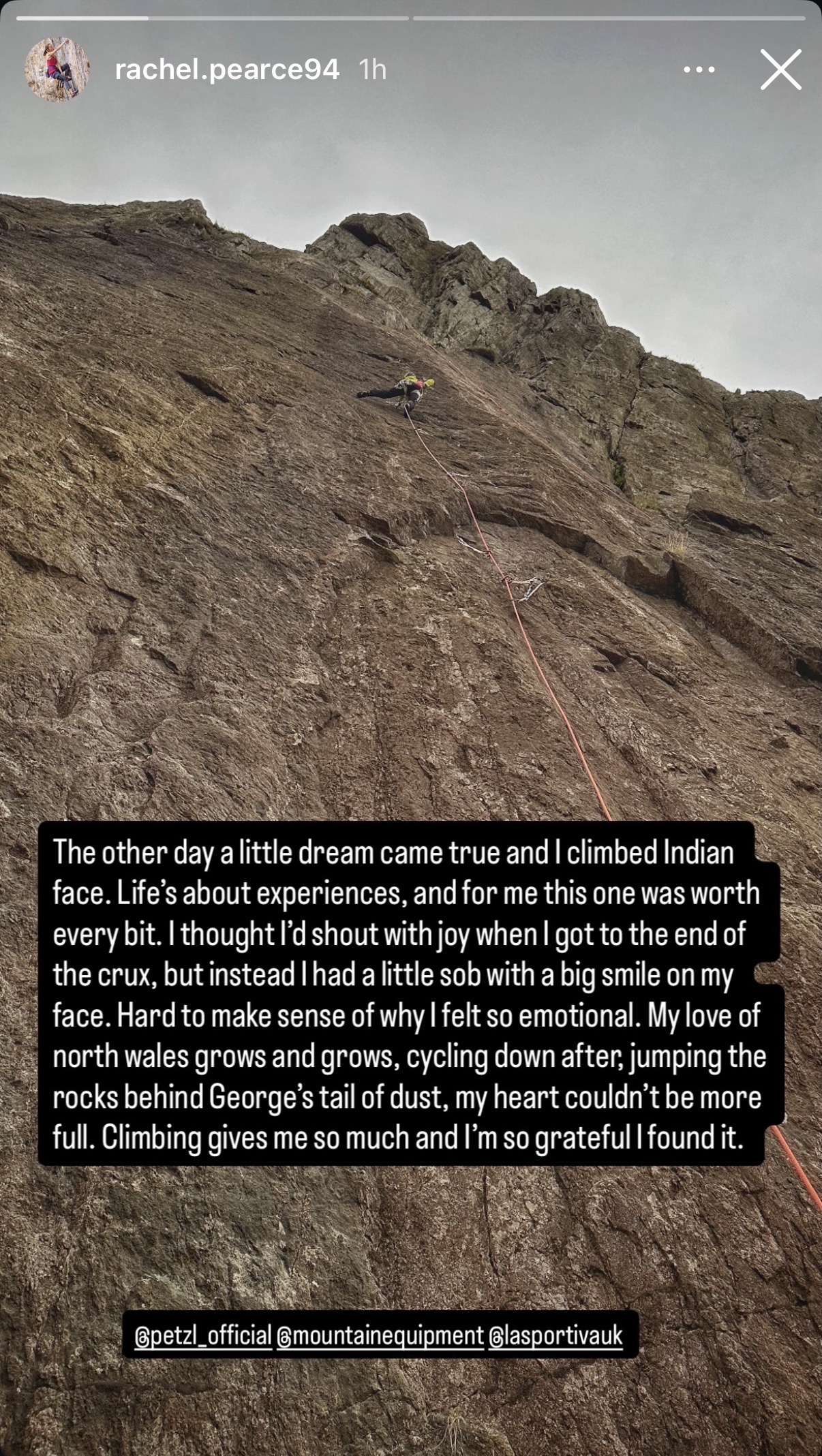
<p>The route was then neglected for some time, its aura growing. <a href="/climber/146/dave-macleod" rel="noopener noreferrer">Dave MacLeod</a> backed off it in 2007, before returning better-prepared in 2010 to make a flawless headpoint. A relative flood of repeats in a similar style followed in the dry summer 2013, with McHaffie dispatching the route in a day. <a href="/climber/1604/morus-sanderson" rel="noopener noreferrer">Morus Sanderson</a> unintentionally channeled some of the spirit of earlier adventures on the wall with a harrowing repeat on wet holds in 2023. <a href="/climber/543/rachel-pearce" rel="noopener noreferrer">Rachel Pearce</a> made the first female ascent in 2026.</p>
<h3>References</h3>
<p>[1] <a href="/climber/747/paul-williams" rel="noopener noreferrer">Paul Williams</a>. Clogwyn Du'r Arddu. United Kingdom: Climbers' Club, 1989.</p>
<p>[2] <a href="/library/7496/e9-6c" rel="noopener noreferrer">E9 6c</a></p>
<p>[3] <em>Mountain</em> Issue 134 (1990), page 14 <a href="/library/11317/mountain-134" rel="noopener noreferrer">/library/11317/mountain-134</a></p>
<p>[4] <a href="https://podcasts.apple.com/gb/podcast/jam-crack-the-niall-grimes-climbing-podcast/id1065991509?i=1000637614429" rel="noopener noreferrer">https://podcasts.apple.com/gb/podcast/jam-crack-the-niall-grimes-climbing-podcast/id1065991509?i=1000637614429</a></p>
After
<p>Perhaps the most celebrated and revered route in the UK, <a href="/climber/561/johnny-dawes" rel="noopener noreferrer">Johnny Dawes</a>' ascent in 1986 gave the country its first E9. Although only around 7b/+ to top rope, the route is exceptionally bold, running it out way above bodyweight-only RPs in suspect placements. A fall from the precarious crux at around 40m would likely end on the ground. </p>
<p>A narrow resting foothold before the crux sequence allows the leader a moment's respite and an opportunity to contemplate their fate. <a href="/climber/173/neil-gresham" rel="noopener noreferrer">Neil Gresham</a> remarked that without this 'ledge' the route might only be E8.</p>
<p>Memorably described in <a href="/climber/747/paul-williams" rel="noopener noreferrer">Paul Williams'</a> 1988 guidebook as follows:</p>
<blockquote>
<p>Standard: E9; Exceptionally Severe (Excessively so). Rubbers.</p>
<p>It has been said that up the face to the right of <a href="/climb/1075/a-midsummer-night's-dream" rel="noopener noreferrer">A Midsummer Night's Dream</a>, a pitch of such appalling difficulty as to be almost beyond the realms of human comprehension has been ascended without mechanical machinations or other insidious practices normally associated with a route of this calibre. The crux is as fearsome a piece of climbing as has yet been seen in Snowdonia; harder than the Horned Crag, or perhaps even the
Gambit Climb of Crib y Ddysgl (though this may be to overstate).</p>
<p>A preliminary inspection on the rope is certainly advisable. Where the crux (of an obduracy to satisfy even the most advanced of ambitions) to be even so little as two feet longer, it is a matter much to be doubted whether even so much as a single man possessed of the necessary capacities of temperament, physique and moral character could be found in these islands capable of fulfilling the requirements of such an exacting ascent. Skill and confidence — and both in abundance — are required, though a greater premium may be placed upon fingers possessed of some of the characteristics of tempered steel.</p>
<p>The climbing is on holds unremittingly exiguous in nature — their
paucity proving such a drain upon mental faculties as to daunt the heart of a would-be leader, even though he may be the stoutest of fellows.</p>
<p>Protection is at best illusory; the whole sweep of rock affords not so much as a single nubbin on which the thinnest line may be secured, nor a single crack in which the most vestigial of chockstones could hope to gain lodgment. Should the leader fail to negotiate the crux, or be seized by a palsy high on the pitch, disaster must be imminent — nay, inevitable, the ground below which would receive his fall being by no means accommodating to such a contingency. The second's faculties should comprehend any eventuality, no matter how dire, which may befall, though medical qualification is supernumary, spiritual rather than temporal care being of more direct assistance in the aftermath of an abrupt descent. Scatological preoccupations are
most likely amongst the preliminaries to an ascent, though it is questionable whether abstinence from carnal pleasure the preceding week would prove advantageous to a man of such moral fibre as would dare to contemplate so audacious an undertaking.</p>
<p>The party should most conveniently number two, the compet-
ence of the leader should, as has previously been noted, be of
an exceptionally high order, whilst that of the second should not
lag far behind.</p>
<p>Rope: A full 150 feet of Alpine line will be found necessary for
each member of the party, though more would add to the
comfort, both mental and spiritual.</p>
<p>...</p>
<p>The successful leader, even though he be of a modest disposition, may relax, and justifiably award himself a 'pat on the back'. [1]</p>
</blockquote>
<p>After the first ascent there was some controversy, with a flake parting company with the route and <a href="/climber/623/john-redhead" rel="noopener noreferrer">John Redhead</a> painting a picture in the scar left behind. This was subsequently removed and became a further source of prime beef between the pair. In 1980, John had made some extraordinary efforts to climb the line, resulting in <a href="/climb/1089/the-tormented-ejaculation" rel="noopener noreferrer">The Tormented Ejaculation</a> and he took umbrage with Dawes top-roping the line of Indian Face before leading it.</p>
<p><a href="/climber/561/johnny-dawes" rel="noopener noreferrer">Johnny Dawes</a>:</p>
<blockquote>
<p>The real shame is that John [Redhead] can't accept that other people are special too. John thinks he's special. Well a lot of other people are special too John. [2]</p>
</blockquote>
<p>At some point a mystery chipped nut placement appeared which would have made the route substantially safer. This was filled in with epoxy resin by <a href="/climber/561/johnny-dawes" rel="noopener noreferrer">Johnny Dawes</a> in 1990. [3]</p>
<p>The route was repeated in 1994 by Neil Gresham and <a href="/climber/540/nick-dixon" rel="noopener noreferrer">Nick Dixon</a>. In 1996 following <a href="/climber/574/leo-houlding" rel="noopener noreferrer">Leo Houlding</a>'s onsight ascent of <a href="/climb/713/master's-wall" rel="noopener noreferrer">Master's Wall</a>, up which the route starts, there was speculation about the possibility of an onsight of Indian Face. However, once Leo discovered Yosemite, Welsh death routes no longer seemed so appealing [4] and <a href="/climber/138/james-mchaffie" rel="noopener noreferrer">James McHaffie</a>'s epic on Master's Wall in 2000 quenched the onsight dream, seemingly for good.</p>
<p>The route was then neglected for some time, its aura growing. <a href="/climber/146/dave-macleod" rel="noopener noreferrer">Dave MacLeod</a> backed off it in 2007, before returning better-prepared in 2010 to make a flawless headpoint. A relative flood of repeats in a similar style followed in the dry summer 2013, with McHaffie dispatching the route in a day. <a href="/climber/1604/morus-sanderson" rel="noopener noreferrer">Morus Sanderson</a> unintentionally channeled some of the spirit of earlier adventures on the wall with a harrowing repeat on wet holds in 2023. <a href="/climber/543/rachel-pearce" rel="noopener noreferrer">Rachel Pearce</a> made the first female ascent in 2026.</p>
<h3>References</h3>
<p>[1] <a href="/climber/747/paul-williams" rel="noopener noreferrer">Paul Williams</a>. Clogwyn Du'r Arddu. United Kingdom: Climbers' Club, 1989.</p>
<p>[2] <a href="/library/7496/e9-6c" rel="noopener noreferrer">E9 6c</a></p>
<p>[3] <em>Mountain</em> Issue 134 (1990), page 14 <a href="/library/11317/mountain-134" rel="noopener noreferrer">/library/11317/mountain-134</a></p>
<p>[4] <a href="https://podcasts.apple.com/gb/podcast/jam-crack-the-niall-grimes-climbing-podcast/id1065991509?i=1000637614429" rel="noopener noreferrer">https://podcasts.apple.com/gb/podcast/jam-crack-the-niall-grimes-climbing-podcast/id1065991509?i=1000637614429</a></p>
|
|||||||
| 48 | 19th August 2026 | 09:57:49 UTC | Mono | climb | Indian Face | notes | |
|
Before
Perhaps the most celebrated and revered route in the UK, [Johnny Dawes](/climber/561/johnny-dawes)' ascent in 1986 gave the country its first E9. Although only around 7b/+ to top rope, the route is exceptionally bold, running it out way above bodyweight-only RPs in suspect placements. A fall from the precarious crux at around 40m would likely end on the ground.

A narrow resting foothold before the crux sequence allows the leader a moment's respite and an opportunity to contemplate their fate. [Neil Gresham](/climber/173/neil-gresham) remarked that without this 'ledge' the route might only be E8.

Memorably described in [Paul Williams'](/climber/747/paul-williams) 1989 guidebook as follows:

> Standard: E9; Exceptionally Severe (Excessively so). Rubbers.

> It has been said that up the face to the right of [A Midsummer Night's Dream](/climb/1075/a-midsummer-night's-dream), a pitch of such appalling difficulty as to be almost beyond the realms of human comprehension has been ascended without mechanical machinations or other insidious practices normally associated with a route of this calibre. The crux is as fearsome a piece of climbing as has yet been seen in Snowdonia; harder than the Horned Crag, or perhaps even the
Gambit Climb of Crib y Ddysgl (though this may be to overstate).

> A preliminary inspection on the rope is certainly advisable. Where the crux (of an obduracy to satisfy even the most advanced of ambitions) to be even so little as two feet longer, it is a matter much to be doubted whether even so much as a single man possessed of the necessary capacities of temperament, physique and moral character could be found in these islands capable of fulfilling the requirements of such an exacting ascent. Skill and confidence — and both in abundance — are required, though a greater premium may be placed upon fingers possessed of some of the characteristics of tempered steel.

> The climbing is on holds unremittingly exiguous in nature — their
paucity proving such a drain upon mental faculties as to daunt the heart of a would-be leader, even though he may be the stoutest of fellows.

> Protection is at best illusory; the whole sweep of rock affords not so much as a single nubbin on which the thinnest line may be secured, nor a single crack in which the most vestigial of chockstones could hope to gain lodgment. Should the leader fail to negotiate the crux, or be seized by a palsy high on the pitch, disaster must be imminent — nay, inevitable, the ground below which would receive his fall being by no means accommodating to such a contingency. The second's faculties should comprehend any eventuality, no matter how dire, which may befall, though medical qualification is supernumary, spiritual rather than temporal care being of more direct assistance in the aftermath of an abrupt descent. Scatological preoccupations are
most likely amongst the preliminaries to an ascent, though it is questionable whether abstinence from carnal pleasure the preceding week would prove advantageous to a man of such moral fibre as would dare to contemplate so audacious an undertaking.

> The party should most conveniently number two, the compet-
ence of the leader should, as has previously been noted, be of
an exceptionally high order, whilst that of the second should not
lag far behind.

> Rope: A full 150 feet of Alpine line will be found necessary for
each member of the party, though more would add to the
comfort, both mental and spiritual.

> ...

> The successful leader, even though he be of a modest disposition, may relax, and justifiably award himself a 'pat on the back'. [1]

After the first ascent there was some controversy, with a flake parting company with the route and [John Redhead](/climber/623/john-redhead) painting a picture in the scar left behind. This was subsequently removed and became a further source of prime beef between the pair. In 1980, John had made some extraordinary efforts to climb the line, resulting in [The Tormented Ejaculation](/climb/1089/the-tormented-ejaculation) and he took umbrage with Dawes top-roping the line of Indian Face before leading it.

[Johnny Dawes](/climber/561/johnny-dawes):

> The real shame is that John [Redhead] can't accept that other people are special too. John thinks he's special. Well a lot of other people are special too John. [2]

At some point a mystery chipped nut placement appeared which would have made the route substantially safer. This was filled in with epoxy resin by [Johnny Dawes](/climber/561/johnny-dawes) in 1990. [3]

The route was repeated in 1994 by Neil Gresham and [Nick Dixon](/climber/540/nick-dixon). In 1996 following [Leo Houlding](/climber/574/leo-houlding)'s onsight ascent of [Master's Wall](/climb/713/master's-wall), up which the route starts, there was speculation about the possibility of an onsight of Indian Face. However, once Leo discovered Yosemite, Welsh death routes no longer seemed so appealing [4] and [James McHaffie](/climber/138/james-mchaffie)'s epic on Master's Wall in 2000 quenched the onsight dream, seemingly for good.

The route was then neglected for some time, its aura growing. [Dave MacLeod](/climber/146/dave-macleod) backed off it in 2007, before returning better-prepared in 2010 to make a flawless headpoint. A relative flood of repeats in a similar style followed in the dry summer 2013, with McHaffie dispatching the route in a day. [Morus Sanderson](/climber/1604/morus-sanderson) unintentionally channeled some of the spirit of earlier adventures on the wall with a harrowing repeat on wet holds in 2023. [Rachel Pearce](/climber/543/rachel-pearce) made the first female ascent in 2026.

### References

[1] [Paul Williams](/climber/747/paul-williams). Clogwyn Du'r Arddu. United Kingdom: Climbers' Club, 1989.

[2] [E9 6c](/library/7496/e9-6c)

[3] *Mountain* Issue 134 (1990), page 14 [/library/11317/mountain-134](/library/11317/mountain-134)

[4] [https://podcasts.apple.com/gb/podcast/jam-crack-the-niall-grimes-climbing-podcast/id1065991509?i=1000637614429](https://podcasts.apple.com/gb/podcast/jam-crack-the-niall-grimes-climbing-podcast/id1065991509?i=1000637614429)
After
Perhaps the most celebrated and revered route in the UK, [Johnny Dawes](/climber/561/johnny-dawes)' ascent in 1986 gave the country its first E9. Although only around 7b/+ to top rope, the route is exceptionally bold, running it out way above bodyweight-only RPs in suspect placements. A fall from the precarious crux at around 40m would likely end on the ground.

A narrow resting foothold before the crux sequence allows the leader a moment's respite and an opportunity to contemplate their fate. [Neil Gresham](/climber/173/neil-gresham) remarked that without this 'ledge' the route might only be E8.

Memorably described in [Paul Williams'](/climber/747/paul-williams) 1988 guidebook as follows:

> Standard: E9; Exceptionally Severe (Excessively so). Rubbers.

> It has been said that up the face to the right of [A Midsummer Night's Dream](/climb/1075/a-midsummer-night's-dream), a pitch of such appalling difficulty as to be almost beyond the realms of human comprehension has been ascended without mechanical machinations or other insidious practices normally associated with a route of this calibre. The crux is as fearsome a piece of climbing as has yet been seen in Snowdonia; harder than the Horned Crag, or perhaps even the
Gambit Climb of Crib y Ddysgl (though this may be to overstate).

> A preliminary inspection on the rope is certainly advisable. Where the crux (of an obduracy to satisfy even the most advanced of ambitions) to be even so little as two feet longer, it is a matter much to be doubted whether even so much as a single man possessed of the necessary capacities of temperament, physique and moral character could be found in these islands capable of fulfilling the requirements of such an exacting ascent. Skill and confidence — and both in abundance — are required, though a greater premium may be placed upon fingers possessed of some of the characteristics of tempered steel.

> The climbing is on holds unremittingly exiguous in nature — their
paucity proving such a drain upon mental faculties as to daunt the heart of a would-be leader, even though he may be the stoutest of fellows.

> Protection is at best illusory; the whole sweep of rock affords not so much as a single nubbin on which the thinnest line may be secured, nor a single crack in which the most vestigial of chockstones could hope to gain lodgment. Should the leader fail to negotiate the crux, or be seized by a palsy high on the pitch, disaster must be imminent — nay, inevitable, the ground below which would receive his fall being by no means accommodating to such a contingency. The second's faculties should comprehend any eventuality, no matter how dire, which may befall, though medical qualification is supernumary, spiritual rather than temporal care being of more direct assistance in the aftermath of an abrupt descent. Scatological preoccupations are
most likely amongst the preliminaries to an ascent, though it is questionable whether abstinence from carnal pleasure the preceding week would prove advantageous to a man of such moral fibre as would dare to contemplate so audacious an undertaking.

> The party should most conveniently number two, the compet-
ence of the leader should, as has previously been noted, be of
an exceptionally high order, whilst that of the second should not
lag far behind.

> Rope: A full 150 feet of Alpine line will be found necessary for
each member of the party, though more would add to the
comfort, both mental and spiritual.

> ...

> The successful leader, even though he be of a modest disposition, may relax, and justifiably award himself a 'pat on the back'. [1]

After the first ascent there was some controversy, with a flake parting company with the route and [John Redhead](/climber/623/john-redhead) painting a picture in the scar left behind. This was subsequently removed and became a further source of prime beef between the pair. In 1980, John had made some extraordinary efforts to climb the line, resulting in [The Tormented Ejaculation](/climb/1089/the-tormented-ejaculation) and he took umbrage with Dawes top-roping the line of Indian Face before leading it.

[Johnny Dawes](/climber/561/johnny-dawes):

> The real shame is that John [Redhead] can't accept that other people are special too. John thinks he's special. Well a lot of other people are special too John. [2]

At some point a mystery chipped nut placement appeared which would have made the route substantially safer. This was filled in with epoxy resin by [Johnny Dawes](/climber/561/johnny-dawes) in 1990. [3]

The route was repeated in 1994 by Neil Gresham and [Nick Dixon](/climber/540/nick-dixon). In 1996 following [Leo Houlding](/climber/574/leo-houlding)'s onsight ascent of [Master's Wall](/climb/713/master's-wall), up which the route starts, there was speculation about the possibility of an onsight of Indian Face. However, once Leo discovered Yosemite, Welsh death routes no longer seemed so appealing [4] and [James McHaffie](/climber/138/james-mchaffie)'s epic on Master's Wall in 2000 quenched the onsight dream, seemingly for good.

The route was then neglected for some time, its aura growing. [Dave MacLeod](/climber/146/dave-macleod) backed off it in 2007, before returning better-prepared in 2010 to make a flawless headpoint. A relative flood of repeats in a similar style followed in the dry summer 2013, with McHaffie dispatching the route in a day. [Morus Sanderson](/climber/1604/morus-sanderson) unintentionally channeled some of the spirit of earlier adventures on the wall with a harrowing repeat on wet holds in 2023. [Rachel Pearce](/climber/543/rachel-pearce) made the first female ascent in 2026.

### References

[1] [Paul Williams](/climber/747/paul-williams). Clogwyn Du'r Arddu. United Kingdom: Climbers' Club, 1989.

[2] [E9 6c](/library/7496/e9-6c)

[3] *Mountain* Issue 134 (1990), page 14 [/library/11317/mountain-134](/library/11317/mountain-134)

[4] [https://podcasts.apple.com/gb/podcast/jam-crack-the-niall-grimes-climbing-podcast/id1065991509?i=1000637614429](https://podcasts.apple.com/gb/podcast/jam-crack-the-niall-grimes-climbing-podcast/id1065991509?i=1000637614429)
Diff
--- before
|
|||||||
| 49 | 19th August 2026 | 09:45:35 UTC | Mono | media | /file/d4d398d3-6832-9ee3-a078-29c23e527293/IMG_7781.jpeg | url_optimised | |
|
Before
None
After
/file/9ee6ff52-15e2-dedb-df98-bdc1d54ddc37/IMG_7781.jpeg.webp
|
|||||||
| 50 | 19th August 2026 | 09:45:35 UTC | Mono | media | /file/d4d398d3-6832-9ee3-a078-29c23e527293/IMG_7781.jpeg | attribution_climber_id | |
|
Before
None
After
543
|
|||||||
| 51 | 19th August 2026 | 09:45:35 UTC | Mono | media | /file/d4d398d3-6832-9ee3-a078-29c23e527293/IMG_7781.jpeg | missing_right_to_reproduce | |
|
Before
None
After
false
|
|||||||
| 52 | 19th August 2026 | 09:45:35 UTC | Mono | media | /file/d4d398d3-6832-9ee3-a078-29c23e527293/IMG_7781.jpeg | src | |
|
Before
None
After
|
|||||||
| 53 | 19th August 2026 | 09:45:35 UTC | Mono | media | /file/d4d398d3-6832-9ee3-a078-29c23e527293/IMG_7781.jpeg | url | |
|
Before
None
After
/file/d4d398d3-6832-9ee3-a078-29c23e527293/IMG_7781.jpeg
|
|||||||
| 54 | 19th August 2026 | 01:18:15 UTC | Mono | climb | Great Wall | notes_pretty | |
|
Before
<p><a href="/climber/1959/pete-crew" rel="noopener noreferrer">Pete Crew</a>:</p>
<blockquote>
<p><a href="/climber/612/joe-brown" rel="noopener noreferrer">Brown’s</a> rule at that time was to use no more than two pegs per pitch, he decided to retreat, leaving the abseil peg marking his highest point. Over the years, this peg on the wall became a constant reminder of Brown's superiority over the rest of the field. He tried to climb back up the wall on several occasions but could not get past the difficult lower section. The wall grew in reputation, just as Cenotaph Corner had years before; the final blank section grew from Brown's original estimate to a figure that sometimes reached 40 feet; the wall became known as the Master's Wall - Brown's own territory, on which no-one else dared to trespass, and it was assumed that sooner or later it would fall to the Master... On the Sunday it was still blowing hard, but I persuaded Bas to go up to Cloggy, just to "have a look" at the wall. I think he realised that it was going to be more than just a look when I carried both our 300-foot ropes up to the crag... the first half of the climb went quickly and I arrived at Brown's abseil peg feeling fresh and confident. Neither of us was very keen to belay on the minute stance, so I fixed a couple of runners and carried on. The next 40 feet or so seemed easy and then I came to the final crack. As the chocks were in place I had not brought any up with me. I realised what a mistake this was when the first one dropped out. I moved up again to the next chock, a small pebble, fixed a sling in it and stepped into the sling. The chock split in half. By now I was getting desperate as I could not take much weight off my arms and my last decent runner was about 50 feet below, on the ledge. Just above the split chock the crack almost closed, so I spent the next ten minutes working a sling into this constriction using a peg. By this time I was absolutely shattered - I was half-standing in the sling on the split chock and using a layback hold with one hand. I sat in the sling to have a smoke and the mist cleared a bit ... Once I had recovered the rest went easily ... We had a bit of a problem naming the route. Everyone knew it as the Master's Wall, and if Joe had climbed it, that would have been the perfect name. But it seemed presumptuous so we opted for the Great Wall.</p>
</blockquote>
<h3>References</h3>
<p>[1] <a href="/crag/457/clogwyn-du'r-arddu" rel="noopener noreferrer">Clogwyn Du'r Arddu</a> Guidebook, 1998</p>
After
<p><a href="/climber/1959/pete-crew" rel="noopener noreferrer">Pete Crew</a>:</p>
<blockquote>
<p><a href="/climber/612/joe-brown" rel="noopener noreferrer">Brown’s</a> rule at that time was to use no more than two pegs per pitch, he decided to retreat, leaving the abseil peg marking his highest point. Over the years, this peg on the wall became a constant reminder of Brown's superiority over the rest of the field. He tried to climb back up the wall on several occasions but could not get past the difficult lower section. The wall grew in reputation, just as Cenotaph Corner had years before; the final blank section grew from Brown's original estimate to a figure that sometimes reached 40 feet; the wall became known as the Master's Wall - Brown's own territory, on which no-one else dared to trespass, and it was assumed that sooner or later it would fall to the Master... </p>
<p>On the Sunday it was still blowing hard, but I persuaded Bas to go up to Cloggy, just to "have a look" at the wall. I think he realised that it was going to be more than just a look when I carried both our 300-foot ropes up to the crag... the first half of the climb went quickly and I arrived at Brown's abseil peg feeling fresh and confident. Neither of us was very keen to belay on the minute stance, so I fixed a couple of runners and carried on. The next 40 feet or so seemed easy and then I came to the final crack. As the chocks were in place I had not brought any up with me. I realised what a mistake this was when the first one dropped out. I moved up again to the next chock, a small pebble, fixed a sling in it and stepped into the sling. The chock split in half. By now I was getting desperate as I could not take much weight off my arms and my last decent runner was about 50 feet below, on the ledge. Just above the split chock the crack almost closed, so I spent the next ten minutes working a sling into this constriction using a peg. By this time I was absolutely shattered - I was half-standing in the sling on the split chock and using a layback hold with one hand. I sat in the sling to have a smoke and the mist cleared a bit ... Once I had recovered the rest went easily ... </p>
<p>We had a bit of a problem naming the route. Everyone knew it as the Master's Wall, and if Joe had climbed it, that would have been the perfect name. But it seemed presumptuous so we opted for the Great Wall.</p>
</blockquote>
<h3>References</h3>
<p>[1] <a href="/crag/457/clogwyn-du'r-arddu" rel="noopener noreferrer">Clogwyn Du'r Arddu</a> Guidebook, 1998</p>
|
|||||||
| 55 | 19th August 2026 | 01:18:15 UTC | Mono | climb | Great Wall | notes | |
|
Before
[Pete Crew](/climber/1959/pete-crew):

>[Brown’s](/climber/612/joe-brown) rule at that time was to use no more than two pegs per pitch, he decided to retreat, leaving the abseil peg marking his highest point. Over the years, this peg on the wall became a constant reminder of Brown's superiority over the rest of the field. He tried to climb back up the wall on several occasions but could not get past the difficult lower section. The wall grew in reputation, just as Cenotaph Corner had years before; the final blank section grew from Brown's original estimate to a figure that sometimes reached 40 feet; the wall became known as the Master's Wall - Brown's own territory, on which no-one else dared to trespass, and it was assumed that sooner or later it would fall to the Master... On the Sunday it was still blowing hard, but I persuaded Bas to go up to Cloggy, just to "have a look" at the wall. I think he realised that it was going to be more than just a look when I carried both our 300-foot ropes up to the crag... the first half of the climb went quickly and I arrived at Brown's abseil peg feeling fresh and confident. Neither of us was very keen to belay on the minute stance, so I fixed a couple of runners and carried on. The next 40 feet or so seemed easy and then I came to the final crack. As the chocks were in place I had not brought any up with me. I realised what a mistake this was when the first one dropped out. I moved up again to the next chock, a small pebble, fixed a sling in it and stepped into the sling. The chock split in half. By now I was getting desperate as I could not take much weight off my arms and my last decent runner was about 50 feet below, on the ledge. Just above the split chock the crack almost closed, so I spent the next ten minutes working a sling into this constriction using a peg. By this time I was absolutely shattered - I was half-standing in the sling on the split chock and using a layback hold with one hand. I sat in the sling to have a smoke and the mist cleared a bit ... Once I had recovered the rest went easily ... We had a bit of a problem naming the route. Everyone knew it as the Master's Wall, and if Joe had climbed it, that would have been the perfect name. But it seemed presumptuous so we opted for the Great Wall.

### References

[1] [Clogwyn Du'r Arddu](/crag/457/clogwyn-du'r-arddu) Guidebook, 1998
After
[Pete Crew](/climber/1959/pete-crew):

>[Brown’s](/climber/612/joe-brown) rule at that time was to use no more than two pegs per pitch, he decided to retreat, leaving the abseil peg marking his highest point. Over the years, this peg on the wall became a constant reminder of Brown's superiority over the rest of the field. He tried to climb back up the wall on several occasions but could not get past the difficult lower section. The wall grew in reputation, just as Cenotaph Corner had years before; the final blank section grew from Brown's original estimate to a figure that sometimes reached 40 feet; the wall became known as the Master's Wall - Brown's own territory, on which no-one else dared to trespass, and it was assumed that sooner or later it would fall to the Master...

>On the Sunday it was still blowing hard, but I persuaded Bas to go up to Cloggy, just to "have a look" at the wall. I think he realised that it was going to be more than just a look when I carried both our 300-foot ropes up to the crag... the first half of the climb went quickly and I arrived at Brown's abseil peg feeling fresh and confident. Neither of us was very keen to belay on the minute stance, so I fixed a couple of runners and carried on. The next 40 feet or so seemed easy and then I came to the final crack. As the chocks were in place I had not brought any up with me. I realised what a mistake this was when the first one dropped out. I moved up again to the next chock, a small pebble, fixed a sling in it and stepped into the sling. The chock split in half. By now I was getting desperate as I could not take much weight off my arms and my last decent runner was about 50 feet below, on the ledge. Just above the split chock the crack almost closed, so I spent the next ten minutes working a sling into this constriction using a peg. By this time I was absolutely shattered - I was half-standing in the sling on the split chock and using a layback hold with one hand. I sat in the sling to have a smoke and the mist cleared a bit ... Once I had recovered the rest went easily ...

>We had a bit of a problem naming the route. Everyone knew it as the Master's Wall, and if Joe had climbed it, that would have been the perfect name. But it seemed presumptuous so we opted for the Great Wall.

### References

[1] [Clogwyn Du'r Arddu](/crag/457/clogwyn-du'r-arddu) Guidebook, 1998
Diff
--- before
|
|||||||
| 56 | 19th August 2026 | 01:15:45 UTC | Mono | climb | Great Wall | notes | |
|
Before
None
After
[Pete Crew](/climber/1959/pete-crew):

>[Brown’s](/climber/612/joe-brown) rule at that time was to use no more than two pegs per pitch, he decided to retreat, leaving the abseil peg marking his highest point. Over the years, this peg on the wall became a constant reminder of Brown's superiority over the rest of the field. He tried to climb back up the wall on several occasions but could not get past the difficult lower section. The wall grew in reputation, just as Cenotaph Corner had years before; the final blank section grew from Brown's original estimate to a figure that sometimes reached 40 feet; the wall became known as the Master's Wall - Brown's own territory, on which no-one else dared to trespass, and it was assumed that sooner or later it would fall to the Master... On the Sunday it was still blowing hard, but I persuaded Bas to go up to Cloggy, just to "have a look" at the wall. I think he realised that it was going to be more than just a look when I carried both our 300-foot ropes up to the crag... the first half of the climb went quickly and I arrived at Brown's abseil peg feeling fresh and confident. Neither of us was very keen to belay on the minute stance, so I fixed a couple of runners and carried on. The next 40 feet or so seemed easy and then I came to the final crack. As the chocks were in place I had not brought any up with me. I realised what a mistake this was when the first one dropped out. I moved up again to the next chock, a small pebble, fixed a sling in it and stepped into the sling. The chock split in half. By now I was getting desperate as I could not take much weight off my arms and my last decent runner was about 50 feet below, on the ledge. Just above the split chock the crack almost closed, so I spent the next ten minutes working a sling into this constriction using a peg. By this time I was absolutely shattered - I was half-standing in the sling on the split chock and using a layback hold with one hand. I sat in the sling to have a smoke and the mist cleared a bit ... Once I had recovered the rest went easily ... We had a bit of a problem naming the route. Everyone knew it as the Master's Wall, and if Joe had climbed it, that would have been the perfect name. But it seemed presumptuous so we opted for the Great Wall.

### References

[1] [Clogwyn Du'r Arddu](/crag/457/clogwyn-du'r-arddu) Guidebook, 1998
Diff
--- before
|
|||||||
| 57 | 19th August 2026 | 01:15:45 UTC | Mono | climb | Great Wall | notes_pretty | |
|
Before
None
After
<p><a href="/climber/1959/pete-crew" rel="noopener noreferrer">Pete Crew</a>:</p>
<blockquote>
<p><a href="/climber/612/joe-brown" rel="noopener noreferrer">Brown’s</a> rule at that time was to use no more than two pegs per pitch, he decided to retreat, leaving the abseil peg marking his highest point. Over the years, this peg on the wall became a constant reminder of Brown's superiority over the rest of the field. He tried to climb back up the wall on several occasions but could not get past the difficult lower section. The wall grew in reputation, just as Cenotaph Corner had years before; the final blank section grew from Brown's original estimate to a figure that sometimes reached 40 feet; the wall became known as the Master's Wall - Brown's own territory, on which no-one else dared to trespass, and it was assumed that sooner or later it would fall to the Master... On the Sunday it was still blowing hard, but I persuaded Bas to go up to Cloggy, just to "have a look" at the wall. I think he realised that it was going to be more than just a look when I carried both our 300-foot ropes up to the crag... the first half of the climb went quickly and I arrived at Brown's abseil peg feeling fresh and confident. Neither of us was very keen to belay on the minute stance, so I fixed a couple of runners and carried on. The next 40 feet or so seemed easy and then I came to the final crack. As the chocks were in place I had not brought any up with me. I realised what a mistake this was when the first one dropped out. I moved up again to the next chock, a small pebble, fixed a sling in it and stepped into the sling. The chock split in half. By now I was getting desperate as I could not take much weight off my arms and my last decent runner was about 50 feet below, on the ledge. Just above the split chock the crack almost closed, so I spent the next ten minutes working a sling into this constriction using a peg. By this time I was absolutely shattered - I was half-standing in the sling on the split chock and using a layback hold with one hand. I sat in the sling to have a smoke and the mist cleared a bit ... Once I had recovered the rest went easily ... We had a bit of a problem naming the route. Everyone knew it as the Master's Wall, and if Joe had climbed it, that would have been the perfect name. But it seemed presumptuous so we opted for the Great Wall.</p>
</blockquote>
<h3>References</h3>
<p>[1] <a href="/crag/457/clogwyn-du'r-arddu" rel="noopener noreferrer">Clogwyn Du'r Arddu</a> Guidebook, 1998</p>
|
|||||||
| 58 | 19th August 2026 | 01:03:08 UTC | Mono | ascent | Calum Muskett's ascent of Cynefin | Ascent # | |
|
Before
None
After
1
|
|||||||
| 59 | 19th August 2026 | 01:03:08 UTC | Mono | ascent | Calum Muskett's ascent of Cynefin | climb_id | |
|
Before
None
After
8251
|
|||||||
| 60 | 19th August 2026 | 01:03:08 UTC | Mono | ascent | Calum Muskett's ascent of Cynefin | ascent_dt_end | |
|
Before
None
After
2023-05-20
|
|||||||